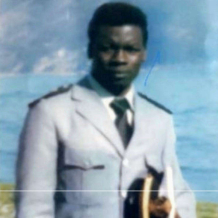
Wele Ousmane Abdallah was an officer in the Mauritanian navy during the Passif humanitaire, a period during which massive human rights violations against Afro-Mauritanian populations were committed between 1986 and 1992.
On November 27, 1990, although the victim had heard rumors about the arrest of Afro-Mauritanian soldiers, he went to his workplace, the Nouadhibou naval base, as usual.
On his way home from work, around 2:00 p.m., his car was stopped by an officer who informed him that he had to return to the marine base. Arriving at his office, he was ambushed by several soldiers who tied his arms and legs behind his back then covered his head with a black cloth before putting him in a military vehicle. The arrest was allegedly carried out on the orders of Captain Abderrahmane Ould Yahya Ould Kouar, Director of the Nouakchott and Nouadhibou marine region.
Wele Ousmane Abdallah was then taken with several other Afro-Mauritanian soldiers in a military vehicle to Inal, located 250 km northeast of Nouadhibou.
The Inal barracks have been the scene of serious human rights violations . On the night of November 27 to 28, 1990, the date of the country’s independence, 28 Afro-Mauritanian soldiers were hanged.
According to the victim’s cousin, Sergeant Mamadou Bayla Wele, himself arrested on November 21, 1990, he was tortured every day from November 27, 1990. The acts of torture ranged from beatings with metal bars to the tying of hands and legs with chains behind the back, up to the beatings inflicted by a group of soldiers.
Wele Ousmane Abdallah was tortured again on the night of December 4, 1990. He died of his injuries the next day.
The day after her husband’s disappearance, the victim’s wife and several wives of soldiers arrested in the context of the Passif humanitaire went to the Nouadhibou naval base to ask for information on the whereabouts of their husbands, in vain.
Finally, after several weeks of waiting, the victim’s wife decided to leave Nouadhibou to return to Djeol, her hometown. A few months after the disappearance of the victim, during a mission led by Captain Ely Vall of the Mauritanian army intelligence office, the latter found the victim’s wife in Kaédi, in the south of Mauritania, to inform her of the victim’s death. The latter then declared that he had died on a mission.
Since then, Wele Ousmane Abdallah’s remains have never been returned to his relatives and they have never been officially informed of the circumstances of his death. They also do not know where Wele Ousmane Abdallah was buried.
In 1993, the authorities promulgated Law No. 93-23, which grants amnesty to members of the security forces for all offenses they may have committed in the exercise of their functions between January 1, 1989 and April 18, 1992. The text specifies that “any complaint, any report and any investigation document relating to this period and concerning a person who benefited from this amnesty will be closed without further action”.
Failing to be able to lodge appeals at the domestic level, the victims and their beneficiaries had no other choice but to turn to international courts. In 2000, Mauritania was condemned by the African Commission on Human and Peoples’ Rights (ACHPR). The Commission found that Mauritania had violated the right to life and the right not to be subjected to torture. The victim’s wife is part of a group of widows who filed this appeal before the ACHPR.
Considering that the government is still obliged to take all appropriate measures for the search, location and release of missing persons and, in the event of death, for the location, respect and restitution of their remains, MENA Rights Group requested the intervention of the United Nations Working Group on Enforced and Involuntary Disappearances (WGEID) on April 17, 2024.
On June 10, 2025, the WGEID addressed a communication to the Government of Mauritania, urging the competent authorities to promptly undertake all necessary search efforts and carry out a proper investigation to clarify the fate of Wele Ousmane Abdallah, establish his whereabouts, and ensure the full respect of his rights.