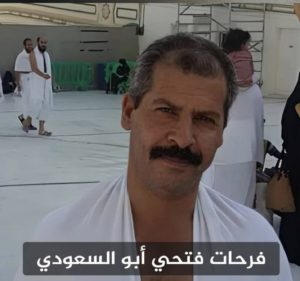
Farhat Fathi Abdel Maksoud Abu Al-Saud is an egyptian national. He lived in Egypt and worked as a driver. On January 28, 2018, Al-Saud was arrested in Saudi Arabia in Duba port by police officers following an inspection of the truck he was driving.. During the inspection, the truck was flagged as suspicious and was therefore searched. Authorities discovered a number of narcotics inside the truck. Upon questioning, Al-Saud stated that he was instructed to deliver the truck to a person in the Riyadh region without knowing what was inside the truck.
He was immediately transferred from Duba port to Tabuk General Prison. Al-Saud denied the charges against him, claiming he had no knowledge of the pills in his truck.
On November 28, 2018, the first hearing on Al-Saud’s case took place before the Criminal Court of first instance in Tabuk. On May 14, 2019, the verdict was issued, where Al-Saud was sentenced to the death penalty under article 37 (1) of the Anti-Narcotics and Psychotropic Substances Law.
Al Saud appealed the decision to the Criminal Court of Appeal. On October 1, 2019, the Criminal Court of Appeal heard the case. The following day, on October 2, 2019, the verdict was issued and confirmed the death sentence handed by the lower court. The sentence was later upheld by the Court of Appeal and the Supreme Court at an unknown date. He is now awaiting execution.
During his detention, Al-Saud remained in solitary confinement for four months, during which time he was unable to communicate with the outside world, and his family was not informed of his detention. Throughout this time, he was regularly subjected to severe acts of torture that led to him getting transferred to the hospital.
On April 25, 2025, MENA Rights Group and partners submit a Request for Opinion to the UN Working Group on Arbitrary Detention (UN WGAD).
On May 24, 2025, the Saudi Ministry of Interior announced the execution of Al-Saud in Tabuk.
On November 24, 2025, the UN WGAD issued its Opinion No. 71/2025, where it determined that al-Saud had been arbitrarily deprived of his liberty without legal basis and in violation of his rights to a fair trial and to non-discrimination. Furthermore, the UN WGAD found that imposing the death penalty for non-violent drug offences is disproportionate and incompatible with the principles of legality and proportionality governing criminal offences and penalties. It stated that the death penalty may only be imposed for the “most serious crimes”, a threshold that has consistently been interpreted as limited to crimes of extreme gravity involving intentional killing. Accordingly, the UN WGAD concluded that al-Saud’s execution constituted an arbitrary deprivation of life in violation of article 3 of the Universal Declaration of Human Rights.